
To write in Theban is to veil your words in sacred mystery — to speak in a language that belongs to the craft, and to the craft alone.
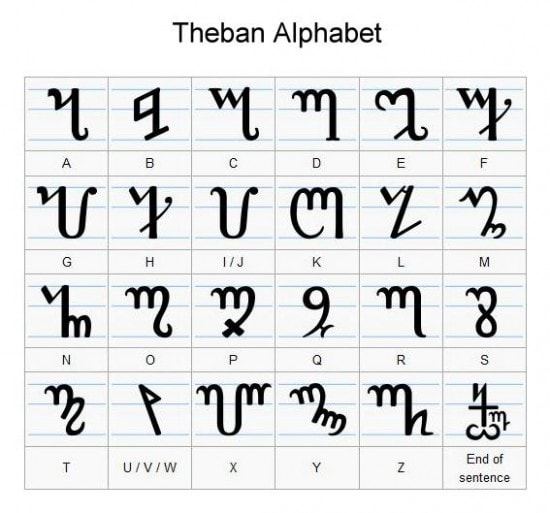
The Theban alphabet — also known as the Witches' Alphabet, the Honorian Alphabet, or the Runes of Honorius — is one of the most widely used scripts in modern witchcraft and ceremonial magic. Each of its characters corresponds to a letter of the Latin alphabet, making it a cipher rather than a language of its own.
Its origins are traced to Heinrich Cornelius Agrippa, who included it in his Three Books of Occult Philosophy (1531), attributing it to Honorius of Thebes. Whether Honorius was a real figure or a mythologised one, the alphabet that bears his name has endured for nearly five centuries — passed through grimoires, covens, and Books of Shadows to the present day.
Witches use Theban to write spells, label ritual tools, inscribe candles, and keep the contents of their Books of Shadows private. There is power in concealment — in choosing who may read your words. Writing in Theban is itself an act of intention.
The Alphabet
Each glyph is shown with its Latin equivalent. Note: Theban has no separate character for J (use I), U and V share one glyph, and there is a special character for ET (and). Hover over any card to see the shape description.
How to Use the Theban Alphabet
Theban is used exactly as you would use the Latin alphabet — letter for letter. You write your English words, substituting each letter for its Theban equivalent. Punctuation and spacing remain the same. There is no separate character for J (use I instead), and U and V share a single glyph.
Common uses in practice
- ✦Inscribing candles. Write your intention or the name of what you are calling in along the length of a candle before burning it.
- ✦Labelling ritual tools. Mark your athame, wand, or cauldron with your craft name or a protective word in Theban.
- ✦Your Book of Shadows. Write spells, rituals, or personal entries in Theban to keep them private and to add a layer of sacred intention to the writing itself.
- ✦Sigil work. Use Theban letters as the basis for creating personal sigils — reduce your intention to its key letters, write them in Theban, and combine the strokes into a single symbol.
- ✦Altar cloths and talismans. Embroider or paint Theban words onto cloth, paper, or wood as part of a charm or talisman.
Learning Theban takes time and practice, but many witches find that the act of writing slowly and deliberately in an unfamiliar script deepens their focus and intention. The effort itself becomes part of the magic.
May your words be veiled in mystery, and your intentions carried on the breath of the craft.
Explore Your Path Further
If you would like guidance on your craft journey — whether through tarot, earth healing, or a deeper conversation about your practice — I would be honoured to sit with you.
Book a Reading